The Brutal Effort of Choosing a Portfolio Web Platform
Dec 1, 2025
When I was photographing Money Management Institute’s Thrive Forum earlier this year, one moment stood out. An attendee shared his company’s recent struggles with redesigning their website, and he lamented about how frustrating it was that the project took a whole year. A voice rang out from the crowd: “Only a year? That’s SHORT!” Everybody laughed, because we all knew the heckler was right.
To state the obvious, designing a website is hard! It involves far more than just the visual design: you also need strategy, UX design, wireframing, user journey mapping, copywriting, project management, development, infrastructure, and dozens of other skills all working in tandem to create a good result.
Imagine for a moment you had to do that all by yourself, with crazy high stakes, and you’ve just stepped into the shoes of designers everywhere working on their portfolio websites.
It’s honestly kind of brutal when you think about it, especially with how competitive the industry can be.
There’s a running joke amongst designers that we always procrastinate on updating our portfolios. We work on amazing things for other people but drop the ball for ourselves. It’s not hard to see why – it’s a lot of unpaid labor, especially when working full-time – but it’s also a self-defeating attitude. It’s like eating your vegetables. We all know deep down that it’s good for us, so why is it so hard to actually do it?
Well, there was one big reason I’ve struggled to keep my work up-to-date: I was using Webflow to design and host my portfolio, a great platform for some but not for me. So at the end of last year, I made the decision to redesign my portfolio and migrate it to a different platform: Framer. That decision kicked off a project that, just like the Thrive Forum attendee’s website, became way more involved and took a lot longer than I expected. Still, I’m glad I did it, and I learned a ton throughout the process. Here’s the story:
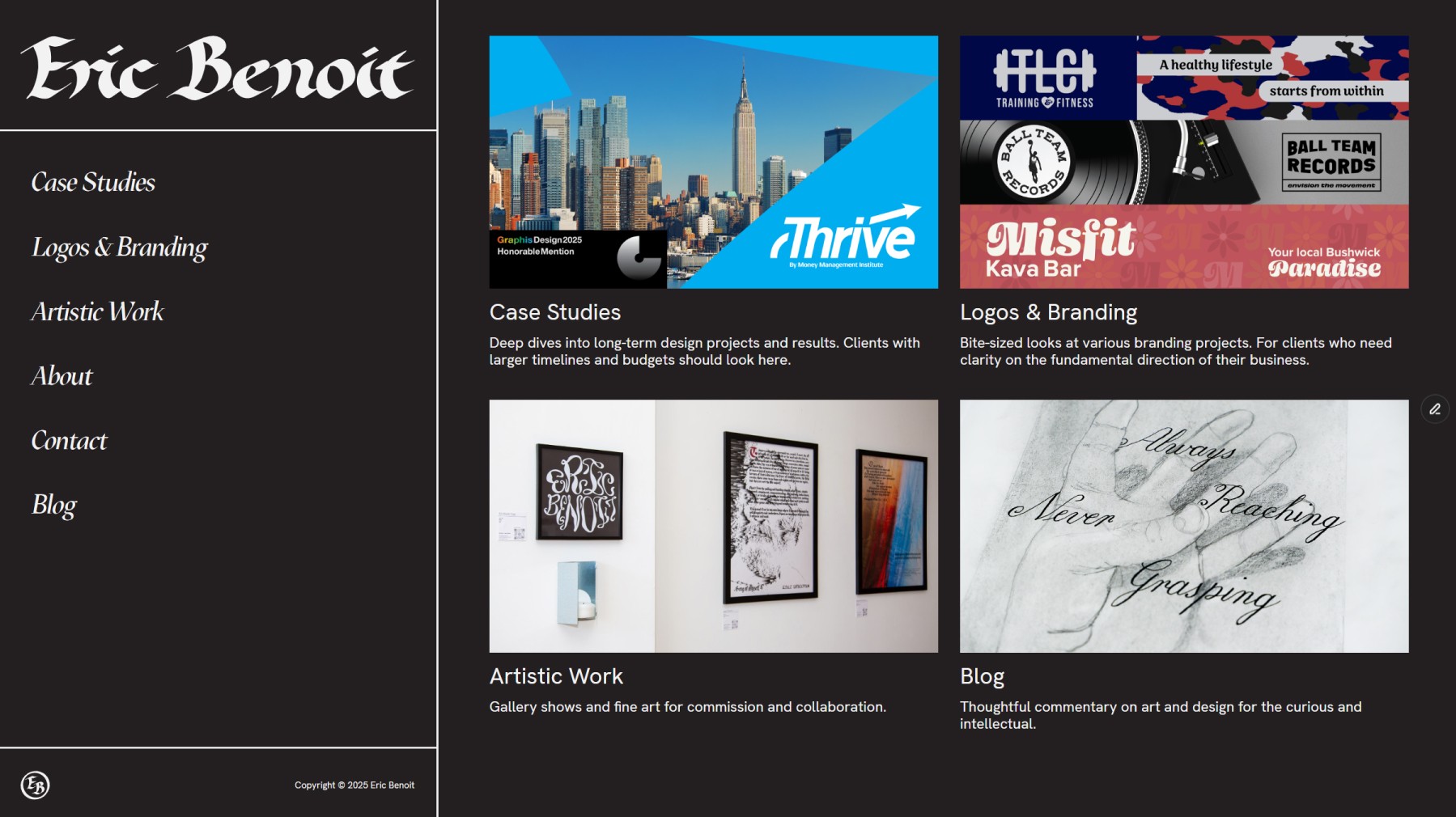
My beautiful new website landing page!
–
Before you jump in and start designing a website, you need to choose the right platform, but this is a surprisingly daunting task.
First off, you face the tyranny of choice. There are dozens of website builders out there, each with their own strengths and weaknesses, plus the option to develop it yourself using a host like Wordpress or Drupal.
As a short, non-exhaustive list, I personally considered: Wix, Squarespace, Shopify, Adobe Portfolio, Cargo, Carrd, Format, Semplice, Readymag, and of course, Webflow and Framer.
I’m probably missing some – there are a LOT of options!
And it gets worse—choosing the right platform for you is incredibly important because you’re likely to spend hundreds of hours using it over the lifespan of your website. You don’t want to sink that kind of time into a platform only to decide that it’s not the right choice. Trust me, I’ve been there, and it sucks.
For me, the decision boiled down to convenience/simplicity vs. customizability. On the one hand, you have platforms like Adobe Portfolio, which are dead simple to get up and running but offer limited flexibility. Squarespace and Wix are better in this regard, but they still rely heavily on templates and pre-built elements.
On the other hand, you have HTML/CSS-based web builders like Webflow or fully custom-coded solutions. These platforms offer full flexibility but have a much steeper learning curve and take more time to develop. Webflow makes things easier by offering a low-code GUI and good templates, but the workflow is still based on HTML, and if (like me) you’re not a developer, it can become frustrating.
In my opinion, Framer offers the best of both worlds—full customizability, good templates and pre-built elements, and a much easier learning curve for designers—which is why I ultimately landed on it.
There’s another element you can’t ignore when choosing a website builder, and it’s the most important one: who is this website for?
If you answered “me!,” you’re wrong! Your portfolio is a tool to help you get more work. It’s for your potential clients, employers, patrons/benefactors, etc, not you. Yes, ultimately it does serve your goals, but if you view it from a selfish perspective, you will find it much harder to connect with the audience you’re looking to serve.
So, before you choose a website builder, and especially before you start designing, I highly encourage you to consider the audience you’re looking to attract and choose a platform that will make it easier for you to do that.
For me, as a brand and communications designer, I boiled it down to three potential audiences:
Freelance clients
Agencies
In-house design teams
Each requires a different approach. Freelance clients need you to solve a specific problem and want to see the ROI on the expensive design investment you’re asking them to make. Agencies want someone who will be profitable for them—meaning your style needs to gel with their house style and you need to show that you work efficiently and get results. In-house teams want someone who can reduce strain on existing resources, contribute to their team’s overall impact, and help grow the company or more effectively achieve its mission.
It took some trial and error, but ultimately, I decided to tailor my portfolio to potential freelance clients. There are a few reasons for this, all related to my future career goals.
For one thing, I love creating brand identities from the ground up but don’t have too many opportunities to do so at my current job. I’d like to gain more experience and add more of that type of work to my portfolio.
Second, I feel it’s an important skill for designers to know how to get high-quality clients independently from their employer.
It isn’t easy—it requires skills in sales, pricing, negotiation, contracts, admin, and all the other stuff that any business owner needs to think about—and it's a competitive market with a lot of low-ballers. They don't teach those skills in design school, but I think they really should. Because on the upside, it's a way to take control of your own destiny as a designer and ultimately increase your value as an employee. The reality of our current job market is that you may be unexpectedly out of work at any moment, so the more leverage you can create for yourself, the better.
And third, in my opinion, having a portfolio tailored to freelance clients can still be appealing to creative directors/agencies/in-house teams, but it doesn’t really go the other way around. If you’re truly making connections and direct sales with your portfolio, you might pique the interest of other players. But an agency-baiting portfolio full of fancy animations and design-forward concept projects usually won’t appeal to a business owner who needs their problem solved NOW. You need to be more direct when speaking to non-designers.
If you're currently going through a portfolio design project, I hoped this post gave you some things to think about in order to make a more informed choice. Good luck!
Want more thoughtful and curious commentary on art and design?
Subscribe below.